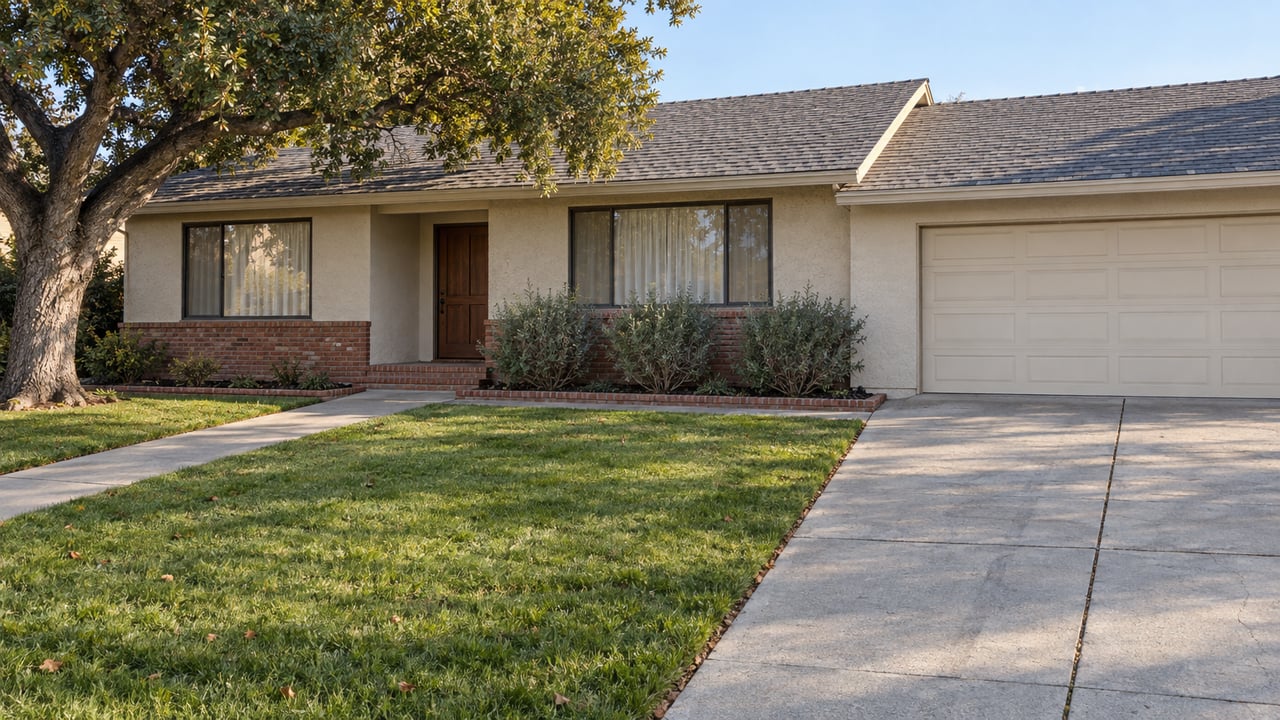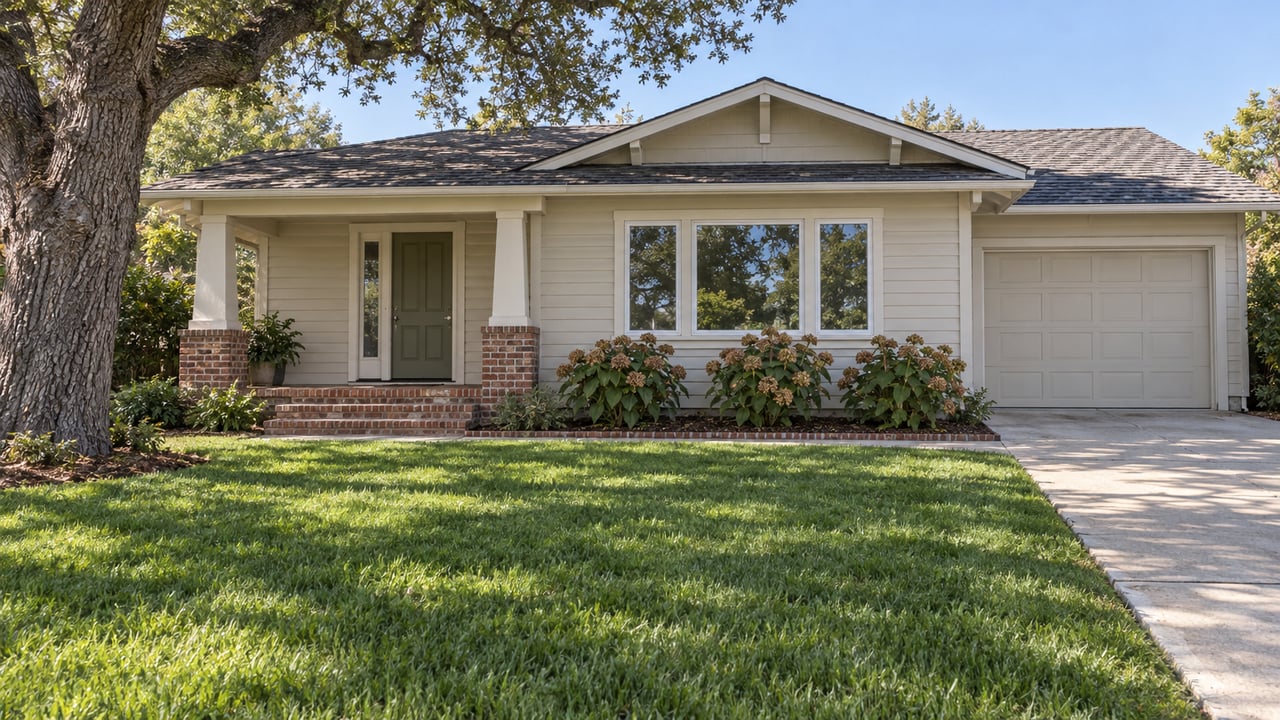
Two similar 1950s ranch houses can sit a few blocks apart, one inside Santa Clara city limits and one in Sunnyvale or San Jose. Their listing prices, square footage and loan payments can be close, but their electric bills are set by two different public bodies. The Santa Clara house gets its power from Silicon Valley Power, the city's own electric utility. The house across the line gets PG&E delivery, which its neighbors pay even when a community choice agency like Silicon Valley Clean Energy supplies the generation.
Silicon Valley Power puts its average residential rate, effective January 1, 2026, at $0.182 per kilowatt-hour. It sets that against $0.422 for PG&E's E-1 tiered plan as of September 1, 2025, a gap of 57%. For a buyer, that gap works like a discount that recurs every month. It is tied to the address, and it grows as the house uses more electricity.
A typical month, priced on both sides of the line
The published D-1 residential schedule, in effect since January 1, 2026, charges $0.15612 per kWh for the first 300 kWh in a month and $0.17946 after that. It adds a $5.11 monthly meter charge and a public-benefits surcharge of 2.85% on the meter and energy charges, plus a separate state surcharge.
A household using 411 kWh in a month comes to about $74 on that schedule before the state surcharge. In January 2026, San José Spotlight used the same 411 kWh and estimated about $75 for a Silicon Valley Power home against about $201 for a PG&E example billed at a peak-time rate. Its PG&E figures date from December 2025.
PG&E changed its bill structure in March 2026. Its residential price summary, effective March 1, 2026, prices E-1 at 33 cents per kWh within the baseline allocation and 41 cents above it. Winter prices on the E-TOU-C time-of-use plan are 40 cents during the 4 to 9 p.m. peak and 37 cents off-peak, and summer prices are 52 and 40 cents. Most customers also pay a new Base Services Charge of about $24 a month. It is about $12 for households enrolled in FERA and $6 for CARE customers.
Assume PG&E billed all 411 of those kWh at E-1's lowest 33-cent price. The energy alone would come to about $136, and the base charge brings it to about $160. That is more than twice the Silicon Valley Power total even in a month that favors PG&E as much as possible. Silicon Valley Power's comparison also leaves out the utility user tax that most PG&E jurisdictions add, typically 5%, which Santa Clara customers do not pay.
Silicon Valley Clean Energy publishes its own estimate of a typical household on its rates page. It puts a 491-kWh E-TOU-C month at $196.38 on its GreenStart service and $200.01 on GreenPrime, based on rates effective January 2026. On Silicon Valley Power's D-1 schedule, the same 491 kWh works out to about $89 before the state surcharge.
| Price per kWh | Silicon Valley Power D-1 | PG&E E-1 | PG&E E-TOU-C, winter |
|---|---|---|---|
| Lower block | $0.15612, first 300 kWh | 33¢, within baseline | 37¢ off-peak |
| Upper block | $0.17946, above 300 kWh | 41¢, above baseline | 40¢ peak, 4 to 9 p.m. |
| Fixed monthly charge | $5.11 meter charge | About $24 Base Services Charge | About $24 Base Services Charge |
| Effective | January 1, 2026 | March 1, 2026 | March 1, 2026 |
Why the gap grows as the house goes electric
The difference matters most at the margin. Each extra 100 kWh above 300 costs $17.95 in Silicon Valley Power energy charges. On PG&E, 100 kWh above baseline on E-1 costs $41, and 100 kWh off-peak in winter on E-TOU-C costs $37. A heat pump, an induction range or a car charging in the garage adds usage on top of the base load. In Santa Clara, that extra usage is priced at less than half the cost.
Silicon Valley Power has no special EV charging rate. Its rates page says Santa Clara residents get the lower rates all day, so they don't need to time charging around a peak window. On a PG&E time-of-use plan, the 4 to 9 p.m. window is when the price peaks.
Gas works differently. Silicon Valley Power sells electricity only, and the city lists PG&E as the gas provider in Santa Clara. A Santa Clara house with a gas furnace and water heater still pays PG&E for those. Every appliance switched from gas to electric moves that load from a PG&E bill to the city's lower rate.
That is the reasoning behind Silicon Valley Power's rebate program, which is open to Santa Clara residents who get their electricity from the utility. The rebate page, last updated July 7, 2026, lists these amounts:
- Gas furnace replaced with a heat pump: $3,000 per ton, capped at $10,000
- Gas water heater replaced with a heat-pump water heater: $5,500
- Smart electrical panel: $4,000, or $1,500 for a main-panel add-on
- Battery storage: $0.15 per watt-hour, up to $2,700
- Residential EV charging station: $350 each, up to two per account
For a buyer looking at an original-condition Santa Clara ranch house with a gas furnace near the end of its life, those numbers change the remodel budget. The rebates cover part of the upgrade, and the electric rate keeps the running cost low afterward. For a seller, a house that has already been converted gets the full benefit of the city's rate on its future electric bills.
Who sets the price, and what is pushing on it
The Santa Clara City Council sets Silicon Valley Power's rates, and it approved increases for both 2025 and 2026. The Council approved a 5% increase effective January 1, 2025. It approved another 4% on December 16, 2025, effective January 2026, citing material and construction costs, infrastructure and reserves. A proposed 2% increase went before the Council on November 17, 2026, and would take effect in January 2027 if approved. The city's notice says Silicon Valley Power's rates would remain among the lowest in California for utilities with more than 10,000 customers.
The increases are small next to the gap with PG&E. A 2% increase on an average of $0.182 adds well under a cent per kWh.
Households make up only a small part of this utility's business. In 2024, San José Spotlight reported that industrial customers accounted for about 92% of Silicon Valley Power's retail sales in fiscal 2023–24 and residential customers about 6%. In May 2025, the same outlet reported 55 operating data centers in Santa Clara. Silicon Valley Power had received requests for about 500 megawatts of additional load against a peak of roughly 720 megawatts, and it had transmission projects underway with expected completion by 2029. In May 2026, Silicon Valley Voice reported that data centers used 60% of the utility's electricity, and it described a pilot program for managing data center computing loads more flexibly.
The utility's stated reasons for its recent increases are materials, construction, infrastructure and reserves. The city posted its notice of the 2027 proposal on October 16, a month before the Council meeting, so homeowners heard about it well before any change would reach a bill.
Checking a specific address before you compare
A Santa Clara mailing address does not by itself mean a house is on Silicon Valley Power. The utility's fact sheet lists a service area of 18.41 square miles and about 54,000 residential accounts on average each month. Its outage page tells customers outside the City of Santa Clara to call PG&E. When two homes near the Sunnyvale, San Jose or Cupertino edges look alike on paper, ask the seller for recent utility bills. They show which provider serves the house and how much electricity it actually uses.
The city also owns its own water and sewer utilities, separate from Silicon Valley Power, so those bills are on the list to compare too. Once you have a realistic monthly electric figure for each house, our mortgage calculator can put the two total monthly costs side by side. Our Santa Clara neighborhood guide and Sunnyvale guide cover the rest of what separates the two cities.
The rates and rebates above are as published on the dates noted. This post is general information, not legal, tax or financial advice, so please confirm your own situation with the utility and the right professional.
If you're weighing a house in Santa Clara against one across the city line, or getting a Silicon Valley Power home ready to sell, KL Real Estate Team can help you put the monthly costs next to the price. Start with a free home valuation and we'll walk you through the numbers for your address.